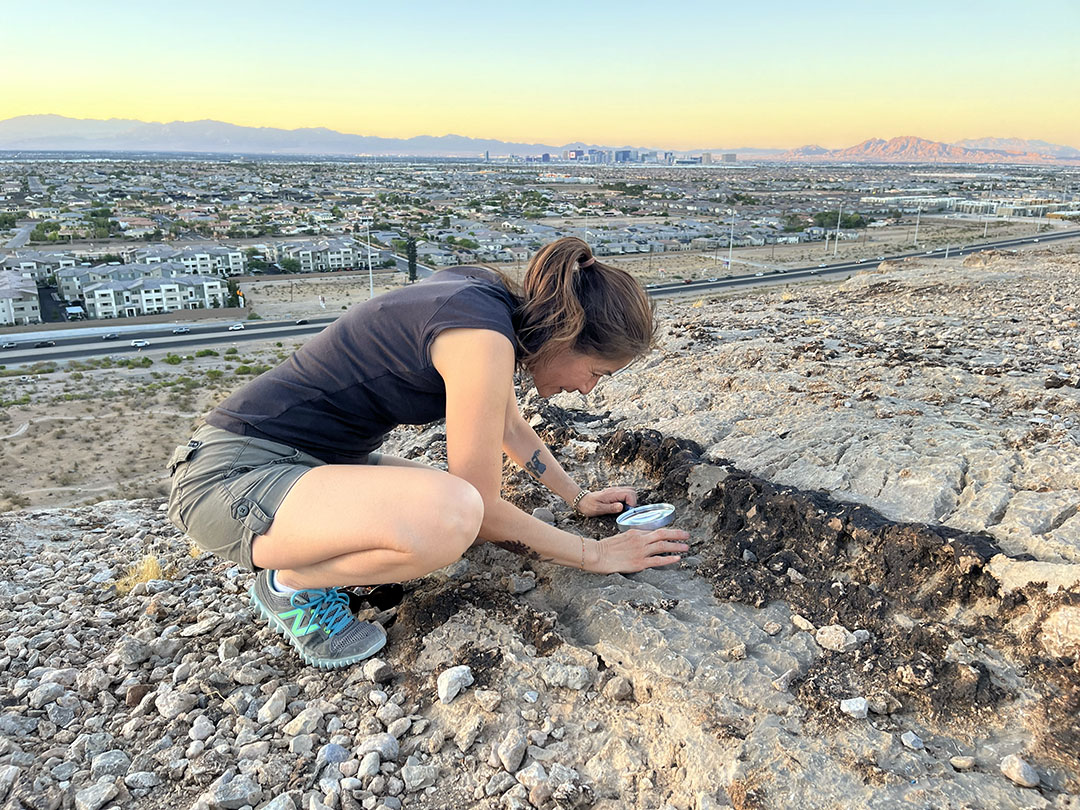
I’m halfway up a rocky hillside, 2,800 feet above sea level, when I spot something ancient embedded in the rock beneath my feet: a once water-loving spiral fossil, glinting in the Nevada sunlight. Not exactly what you expect to find in Las Vegas, a city better known for dazzling lights and show-stopping spectacles. But as you know, I have always been fascinated by soil and stone, the mineralized evidence of everything that came before us – and in Las Vegas, long before the days of spontaneous roulette bets on black and 15-minute chapel weddings.
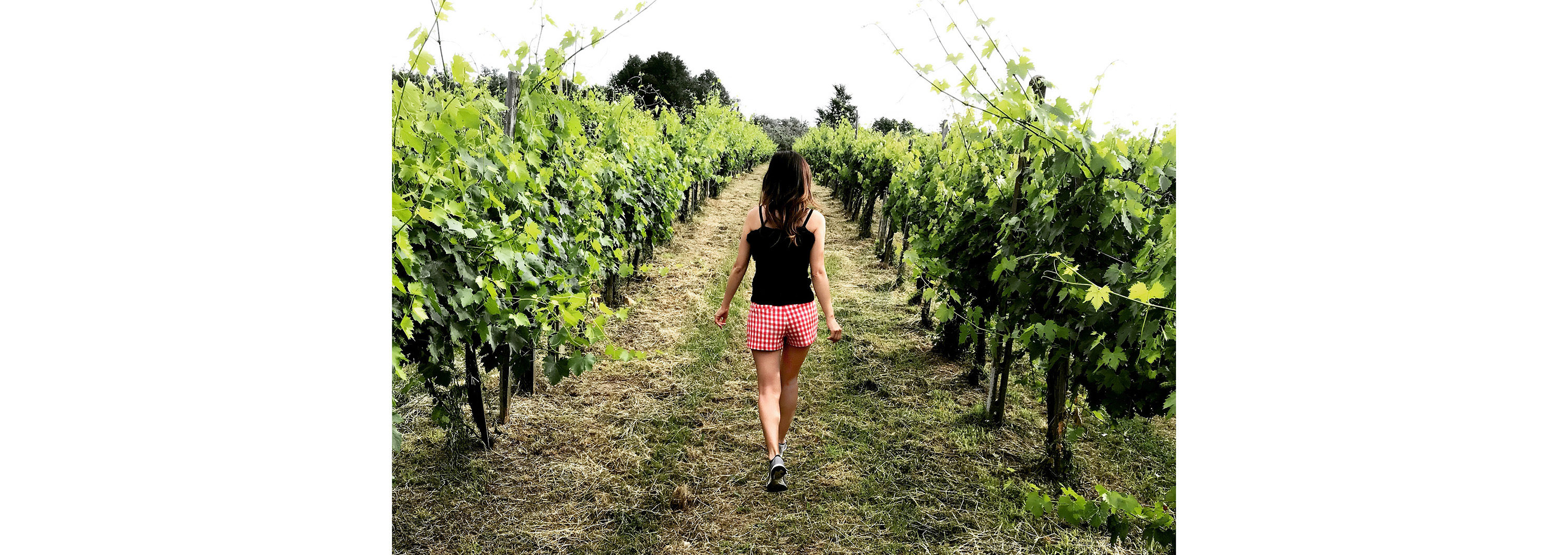
It’s a practice I picked up in vineyards, where what’s beneath your feet is the beginning of understanding the wine in your glass. That same instinct has led me to scramble up hills in the southwest corner of Las Vegas, hunting for rocks and fossils.
I almost studied geology. I’m at peace with that, but I’m still drawn to it, especially when a winemaker rambles off words like “rhyolite,” “limestone,” “Kimmeridgian,” “Tortonian.” Rocks and soil are the original language of place, and fossils are where my inner rock geek loses all sense of moderation.
I have a few spots in southwest Las Vegas where I like to scavenge: an easy hike with stunning Strip views from the summit, and a tougher, pathless climb overlooking the town of Blue Diamond.
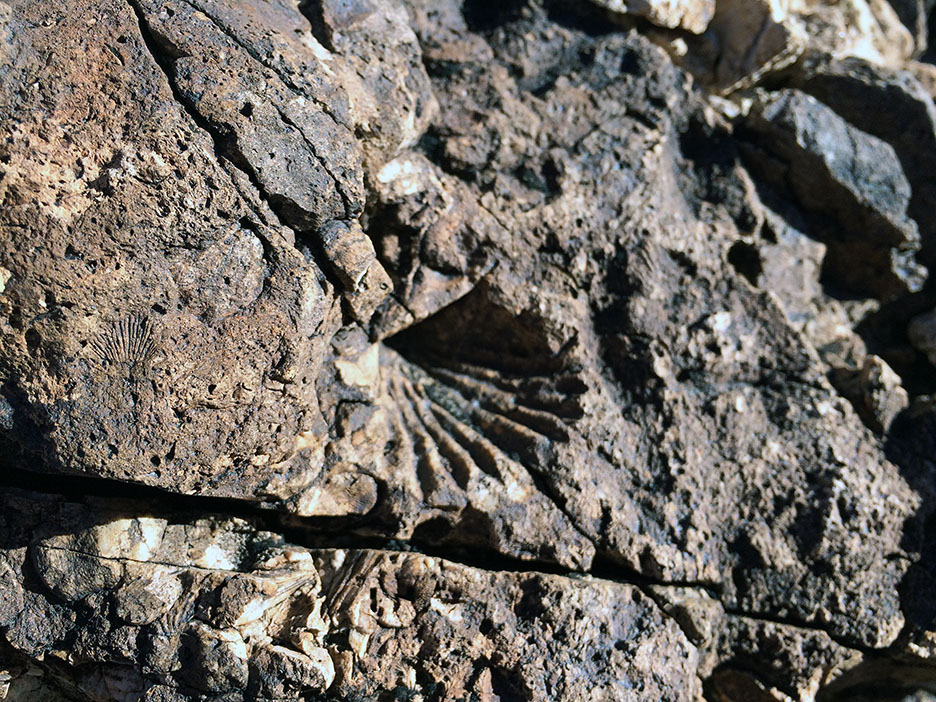
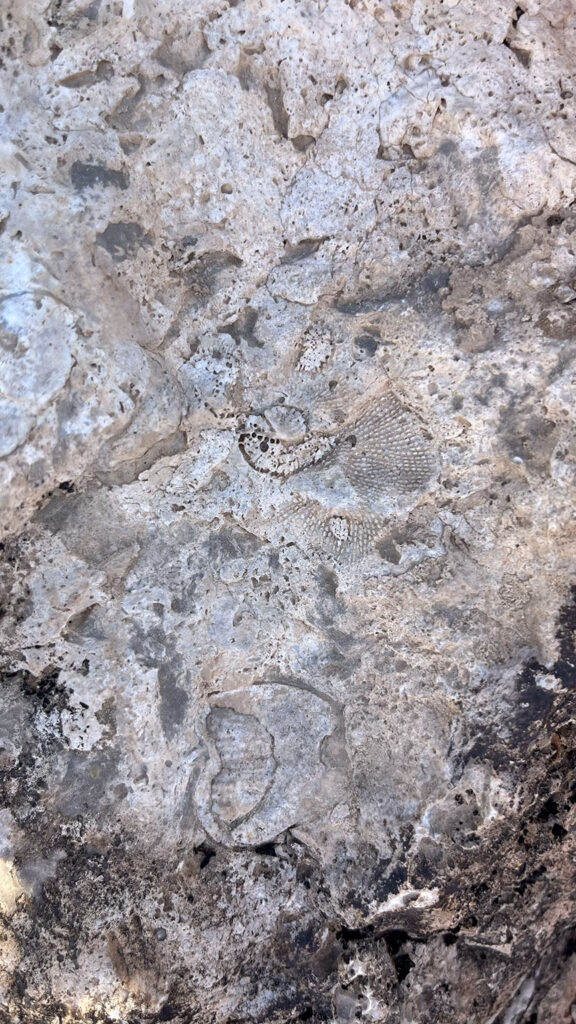
What tipped me off was the dense, grey limestone, laid down some 359 to 323 million years ago. How do I know? Well, I do my research! Plus, the fossils give it away. Brachiopods pressed into the rock like firm thumbprints, crinoid stems stacked like discs from an animal that lived like a flower rooted to the seafloor. And then I found an Archimedes. This was the confirmation- if needed- that I was standing on the Monte Cristo Limestone from the Mississippian subperiod (Paleozoic).
Named after the Greek mathematician; this Archimedes is a corkscrew-shaped bryozoan fossil that, when alive, was surrounded by a lacy spiraling body. It’s named for its spiral axis, which resembles the “Archimedean screw.” But Archimedes went extinct at the end of the Permian (252 million years ago) during a mass extinction caused by dramatic environmental changes. Spotting one is like holding a relic from a vanished world.
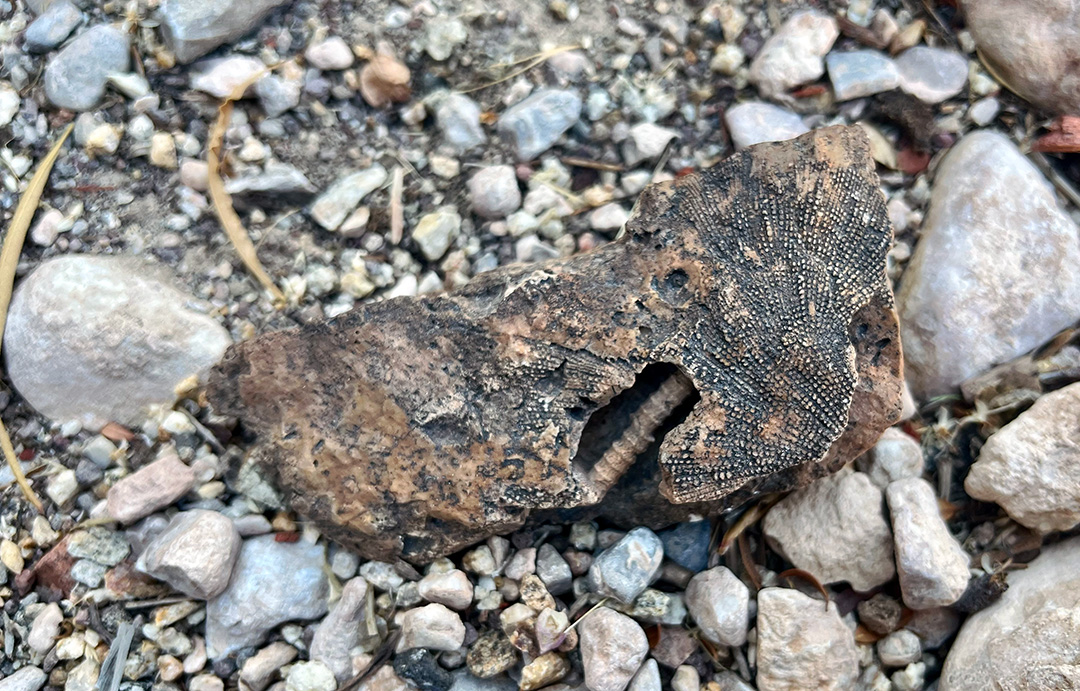
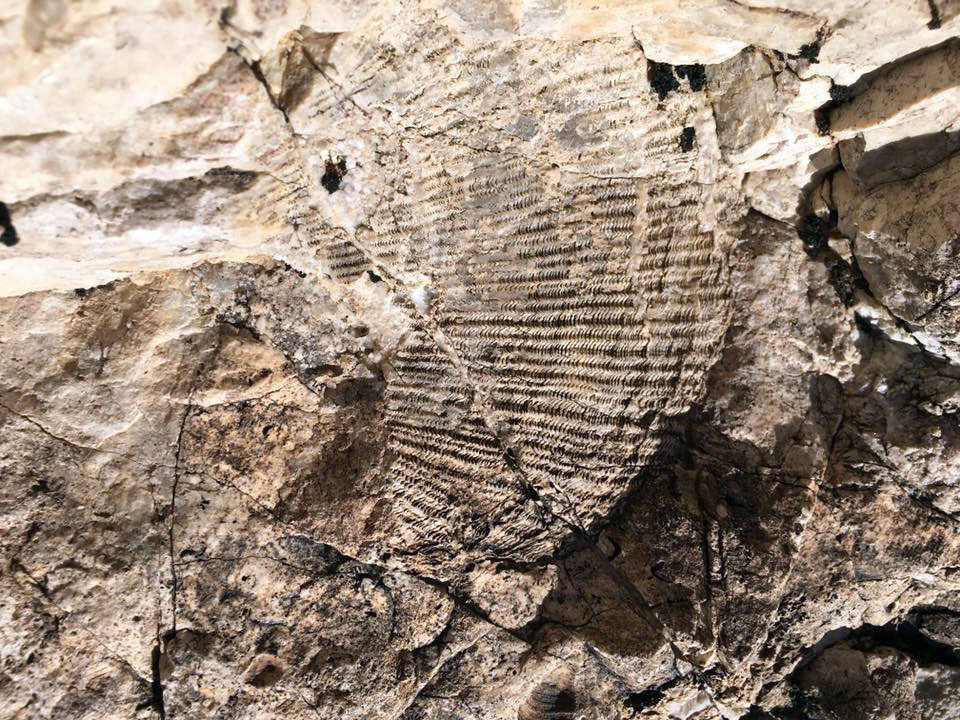
On another hill, a massive fossil spans four feet across with radiating patterns that resemble instant ramen noodles and a mysterious central hole. Maybe it’s a rugose coral, maybe not. Not everything resolves into a tidy label, and honestly, the mystery is half the fun. When you spot a brachiopod (lamp shell) or crinoid (sea lily) from these limestone hills, you’re witnessing organisms from a world that vanished before Pangaea was assembled, before the greatest extinction, and long before dinosaurs roamed the Earth. That’s what makes fossil hunting in Las Vegas so remarkable. These treasured finds are time capsules from an unimaginably ancient sea.
So why are there seashells in the desert? Because this was once the floor of a warm, shallow tropical ocean roughly 10–20 degrees south of the equator. For hundreds of millions of years, southern Nevada was home to crinoids waving their feathery arms like showgirls, Archimedes colonies filtering plankton, and countless other marine creatures. Their shells and skeletons settled into sediment, compacting over time into thousands of feet of limestone.
Then the Mesozoic brought continental drift, thrusting slabs of that ancient seafloor skyward. Erosion did the rest, releasing what was locked inside. Which is how a 330-million-year-old bryozoan ends up sitting in the gravel at a community park in southwest Las Vegas.
This is also why wine people care. In places like Champagne, Burgundy, Barolo, Tuscany, and others, vines grow in soils rich with ancient marine fossils. I felt this most directly in Colli Tortonesi, tasting mineral-driven Derthona wines of Repetto, Massa, and La Colombera. The soil there is Tortonian, named for the epoch itself, laid down as marine sediment 7 to 15 million years ago, when this part of Italy’s Piedmont region was still under the sea. It’s a mere infant next to the Mississippian limestone in my Vegas hills, but both are about a sense of place. Whether I’m hunting fossils or tasting wine, I’m asking the same questions: What happened here? How long ago? And what did it leave behind?
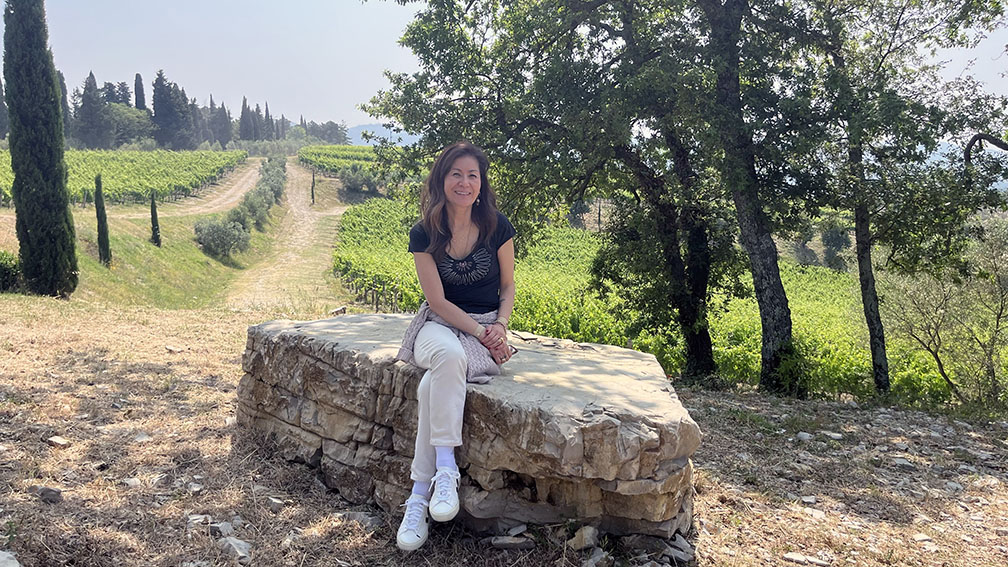
I feel it most clearly in Las Vegas, crouched over an outcrop with the Strip glistening in the distance, a chunk of heavy limestone in hand, a brachiopod pressed into it like a time stamp. It’s not nostalgia because that’s too small a word for something this far back. It’s more like suddenly feeling the full depth of the place you’re standing in. It’s profound and present.